GOBEYONDGOBEYOND

  • The project
    • Project Overview
    • Our Vision
    • Who We Are
    • Advisory Board
  • Co-creation
    • Living Labs
    • Pilot Sites
    • Community of Practice
  • Tools
    • Platforms
    • Product Catalogue
    • Innovation Prize Recap
  • Docs
    • Publications
    • Deliverables
  • News & Events
    • News
    • Events
      • 1st Workshop Recap
      • 2nd Workshop Recap
  • Media
    • Communication Kit
    • Webinars
    • Videos
    • Newsletters
    • Press Releases
  • Contact
Subscribe to our Newsletter
admin
admin
Wednesday, 19 August 2026 / Published in New publications, News

Do hazard-based weather warnings predict real emergency impacts?

A newly published study in the International Journal of Disaster Risk Reduction evaluates our current capacity to anticipate weather-related emergencies. The research was carried out by Jordi Morales (HYDS and UOC), Xavier Llort (HYDS), Andreas Kaltenbrunner (UPF), and Agata Lapedriza (Northeastern University and UOC).

Standard weather warnings are widely used to alert the public and emergency responders to incoming hazards. However, these hazard-based alerts typically ignore crucial local vulnerabilities, such as population distribution and flood susceptibility. The GOBEYOND project aims to overcome this limitation by driving the transition toward sophisticated, impact-based early warning systems. This new study aligns directly with GOBEYOND’s mission by establishing a necessary baseline: quantifying how current operational systems relate to impacts at the local resolution, hour by hour.

To evaluate this, the authors compared rainfall and wind-gust warnings issued by two meteorological agencies in Catalonia, Spain, against actual calls received by the 112 emergency service for flooding and wind damage over a six-year period (October 2018–February 2025).

The key findings reveal a significant gap in current operational models. While existing warnings successfully identify general regions of potential hazard, they suffer from a remarkably high number of false alarms. For example, Level 2 or higher rainfall warnings capture around 40% of all actual impacts, yet show a near 99% false alarm ratio at the local scale. This high frequency of false alarms can severely diminish public trust and reduce the ultimate usefulness of the warnings.

By highlighting both the potential and the limitations of current weather warnings, the research underscores the necessity of improving existing systems with localized, impact-driven approaches to better support emergency management.
Read the publication
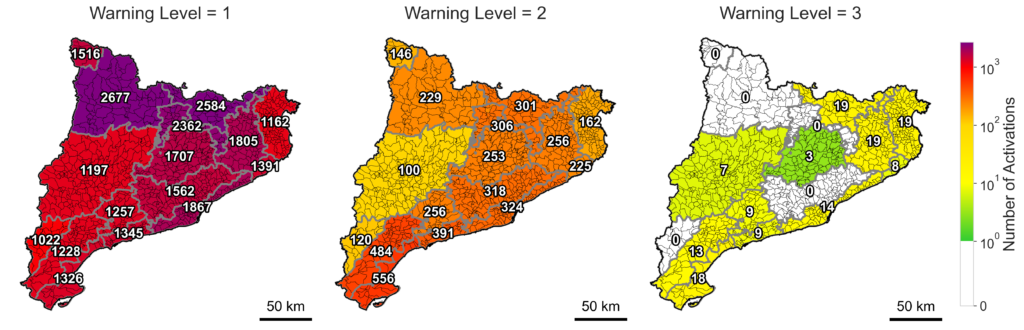
Rainfall warning activations by level (October 2018–February 2025). Total hours of AEMET (Spanish National Meteorological Agency) rainfall-related warning activations per warning level. The spatial distribution of these warnings coincides with the regional climatology: the Pyrenees mountain range to the north concentrates numerous long-duration, lower-intensity rainfall episodes, as reflected by Level 1 warnings. Conversely, the distribution shifts toward the coast (the right boundary), where shorter, more intense events trigger Level 2 and 3 warnings that frequently result in flash floods.
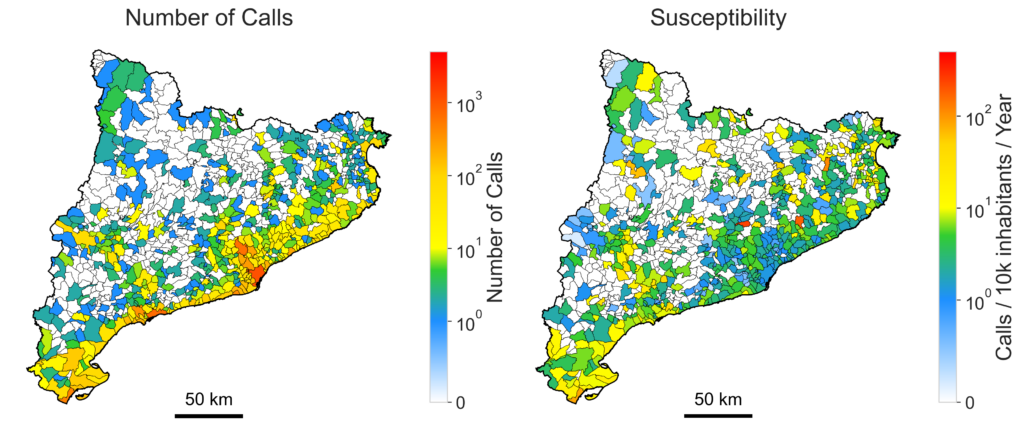
Distribution of emergency calls and susceptibility by municipality (October 2018–February 2025). Spatial distribution of the total number of calls (left) and susceptibility (right) per municipality. Susceptibility is defined as the annual number of calls per 10,000 inhabitants. The majority of emergency calls are concentrated along the coast (the right boundary), where most of Catalonia’s population resides, while interior municipalities register few, if any, calls. This highlights how impacts are ultimately modulated by local characteristics as, per example, population distribution.

  • Tweet

What you can read next

GOBEYOND’s First Living Lab in Attica: A Step Towards Enhanced Civil Protection
Advancing Impact-Based Early Warning in Switzerland: GOBEYOND’s Work in Zurich and Ticino
Publication: User-based analysis of practitioners’ needs to make earthquake warnings more actionable

This project has received funding from the European Union’s Horizon Europe programme for research and innovation under grant agreement No. 101121135. Additional funding is provided by the Swiss Government.

Stay Connected!

Subscribe to our Newsletter!

Privacy Policy

© 2024. All rights reserved.

TOP