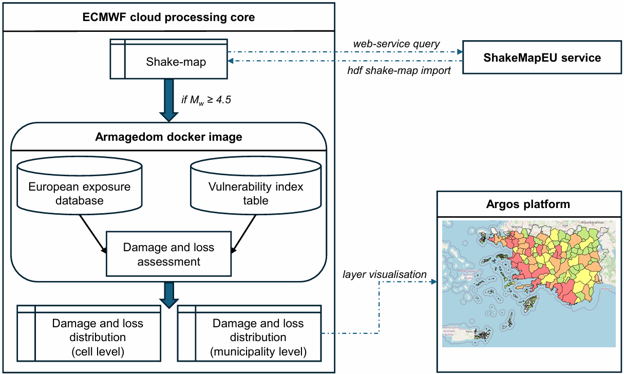
Research activity within GOBEYOND has resulted in a novel method for quickly assessing the impact of earthquakes across Europe. The goal is to provide timely and accurate information to help emergency services respond effectively. The resulting paper, with contributions from BRGM (Pierre Gehl, Caterina Negulescu, Romain Guidez, Samuel Auclair), ECMWF (Darren Snee, Cihan Sahin) and HYDS (Olga Villar, Xavier Llort), was recently published in the International Journal for Disaster Risk Reduction.
The proposed approach relies on two well-established tools and models at European scale: (i) the ShakeMapEU service, which rapidly estimates the seismic intensity following an earthquake, and (ii) the exposure database from the European Seismic Risk Model (ESRM20), which evaluates the vulnerability of buildings. The system categorizes buildings into 44 groups based on their structure, height, and design level. This helps in predicting how much damage buildings might suffer and how many people could be affected. The results are detailed and can be used at the local level, such as for towns or cities, making it easier for civil protection agencies to plan their response.
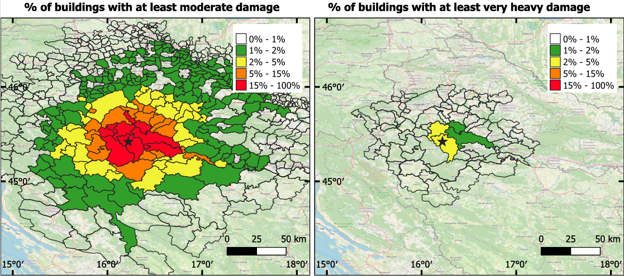
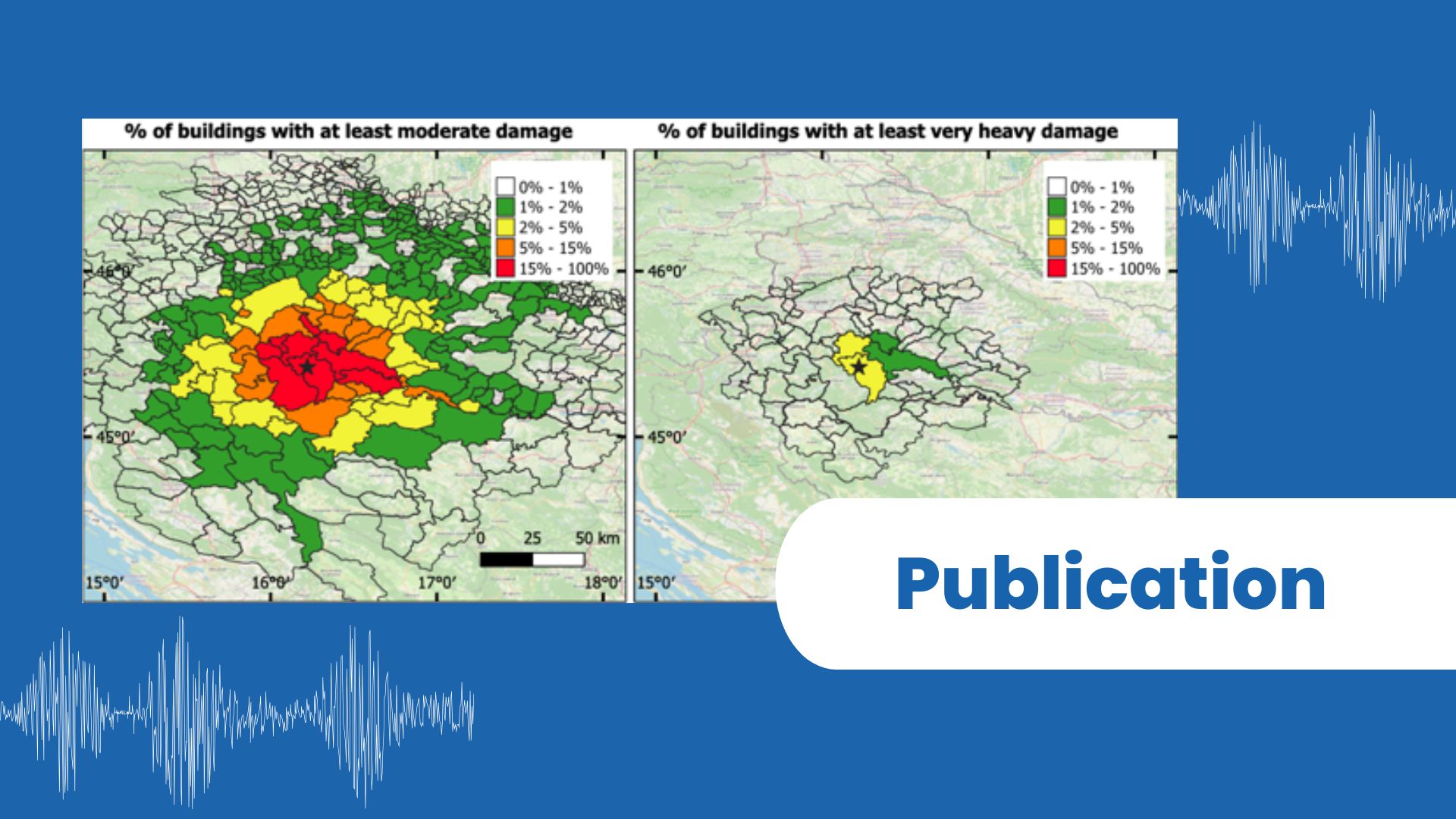
Comparisons with reports from recent damaging earthquakes in Europe show a reasonable agreement with estimates from the proposed approach, in terms of the number of damaged or destroyed buildings and the number of casualties. Two case studies, one in Croatia (Petrinja earthquake, 2020) and another in France (La Laigne earthquake, 2023), also demonstrate how the system can provide detailed impact assessments at the municipal level.
The paper also highlights the challenges in aligning the damage grades used in the model with the actual observations made after an earthquake, which often result from emergency tagging by first responders. This alignment is crucial for improving the accuracy of the model over time.
Overall, this study aims to foster a unified and efficient way to assess earthquake impacts across Europe, addressing the current fragmentation of national systems. It provides a first-level tool for emergency response and disaster management, especially for European countries that are not yet covered by dedicated earthquake rapid response systems.