A study exploring the use of machine learning algorithms for the prediction of 112 in a flood context has recently been published in Natural Hazards and Earth System Sciences (NHESS). The study was conducted by Jordi Morales (HYDS and UOC), Andreas Kaltenbrunner (UPF), Agata Lapedriza (Northeastern University and UOC), and Xavier Llort (HYDS).
Currently, most forecasts and early warning systems rely on hazard-based approaches for the prediction of potential hazards with significant risk to the population. However, as extreme weather events become more frequent and intense, it is increasingly pressing to provide more accurate predictions that take into account information about vulnerable and exposed elements. The GOBEYOND project directly targets this issue by driving the development of early warning systems that are impact-based. Accordingly, this new research aligns directly with GOBEYOND’s objective by presenting an ML approach that combines rainfall-related data with information on vulnerable and exposed elements to predict whether 112 emergencies will occur in the following hour, at the municipal scale and with an hourly temporal resolution.
In total, several models were trained targeting different population density groups (low, medium, and high density). Results were compared against currently operational, hazard-based systems such as official weather warnings over a period of nearly six years (October 2018 to February 2025) in Catalonia, Spain. Moreover, additional experiments were conducted to understand the underlying behaviour of the models.
The key results show that the ML approach represents a substantial improvement in two out of the three groups compared to more traditional methods, both in the reduction of false alarms and in the detection of impacts. The model for the lowest-density group, however, struggles due to a substantial lack of impact data, highlighting a key roadblock for data-driven algorithm development in sparsely populated regions.
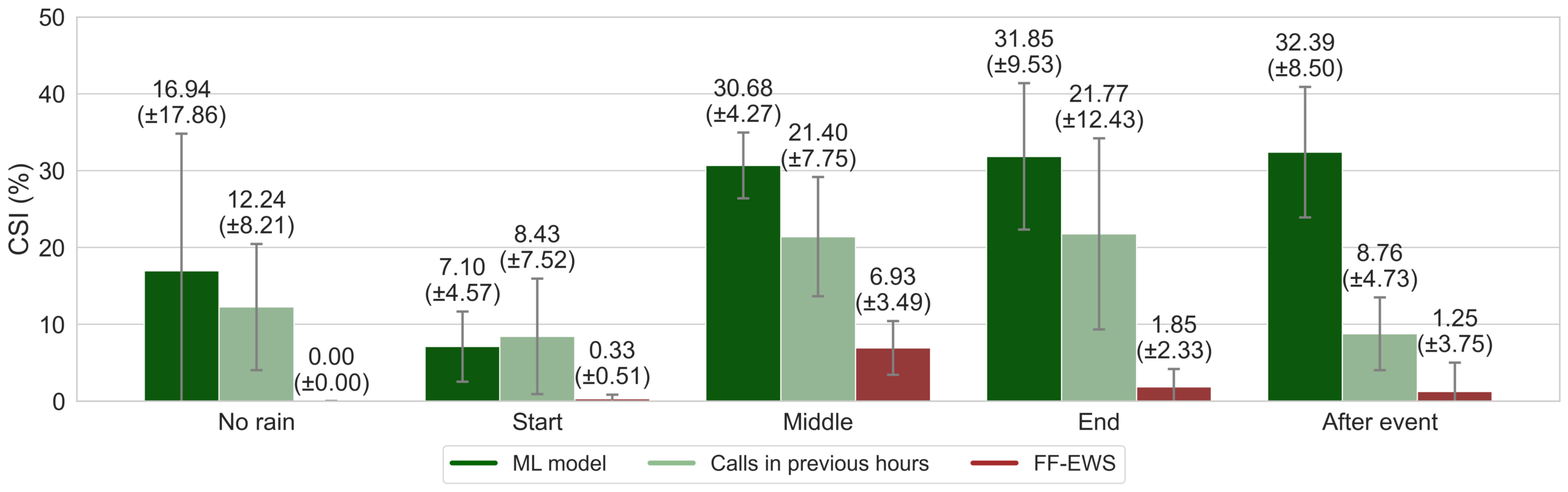
Further experiments on model behaviour also reveal how the ML model performs across different stages of a rainfall event, highlighting not only the hours when rain begins (where performance, although reduced compared to subsequent stages, is still superior than that of traditional approaches), but also the hours after rain has ceased, where hazard-based approaches are typically unable to make predictions, while the ML approach maintains a strong predictive capability.
Ultimately, this study underscores the potential that even simple ML prediction pipelines have to combine diverse data and produce accurate and actionable impact-based predictions to support disaster risk management.