
Co-creating Impact-Based Early Warning for Diverse Regional Needs in Switzerland
In Switzerland, the GOBEYOND project is piloting a regionally adapted version of its Multi-Risk Impact-based Early Warning System (MR-IEWS) in the Cantons of Zurich and Ticino. This Living Lab, led by MeteoSwiss, builds on Switzerland’s strong foundations in hazard monitoring to move toward more actionable, impact-based information for first responders and civil protection actors.
Stakeholders involved:

MeteoSwiss (Federal Office of Meteorology and Climatology)

Cantonal Police and Civil Protection Authorities

Flood Protection Services

Fire Brigades and Ambulance Services

Municipal Mayors and Local Emergency Response Coordinators

Natural Hazard and Risk Management Experts
First Co-Creation Meetings
September 2024

The first in-person Living Lab sessions took place in Ticino and Zürich in September 2024. Organised by MeteoSwiss, the workshops brought together key civil protection stakeholders to map the limitations of existing warning systems and explore how impact-based tools could improve preparedness. Particular attention was given to the gap between short-term thunderstorm alerts and long-duration rainfall warnings, which leaves fast-onset hazards like flash floods largely uncovered.
Participants shared real-life scenarios from both Zürich and Ticino to define their information needs, and discussed the role of language, geography, and governance differences in shaping civil protection response. These insights laid the groundwork for developing a use-case-driven, impact-based prototype tailored to Swiss realities.

Second Meeting – Follow-Up Workshops
April 2025
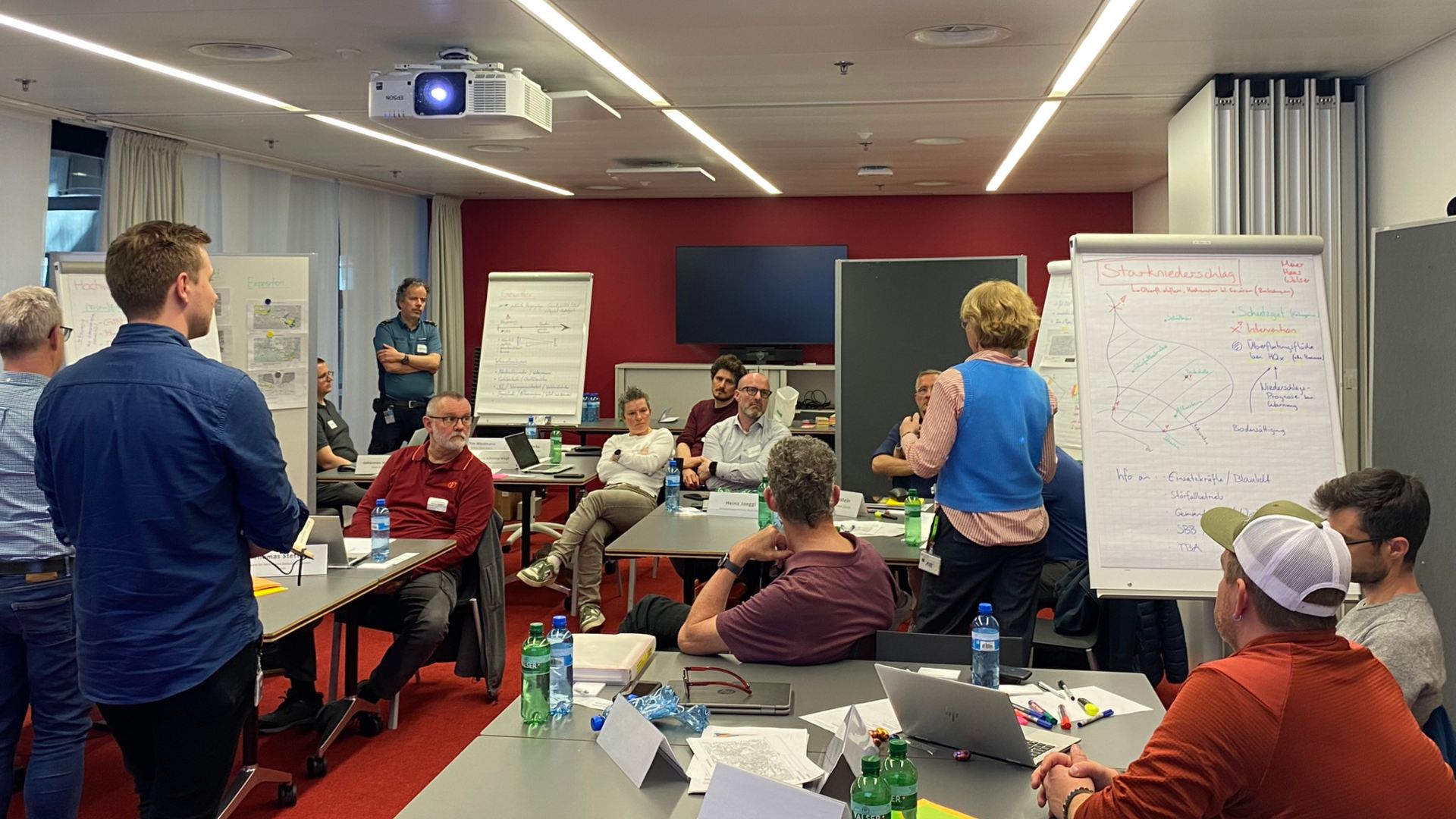
In April 2025, a second round of stakeholder workshops was held in Zürich and Ticino. The sessions built on the initial findings and focused on concrete use cases where impact-based information would significantly enhance decision-making. MeteoSwiss presented an early version of the MR-IEWS prototype and facilitated collaborative exercises to test scenarios and align the system’s outputs with real-time needs of emergency actors.
The workshops highlighted critical parameters such as how quickly data needs to be delivered, what format is most effective for different responders, and how warning chains differ between cantons.
The workshops highlighted critical parameters such as how quickly data needs to be delivered, what format is most effective for different responders, and how warning chains differ between cantons.


This project has received funding from the European Union’s Horizon Europe programme for research and innovation under grant agreement No. 101121135. Additional funding is provided by the Swiss Government.